From Raw Media to Tensors: Preparing Visual Data for Machine Learning
Eliminating the Data Preparation Bottleneck
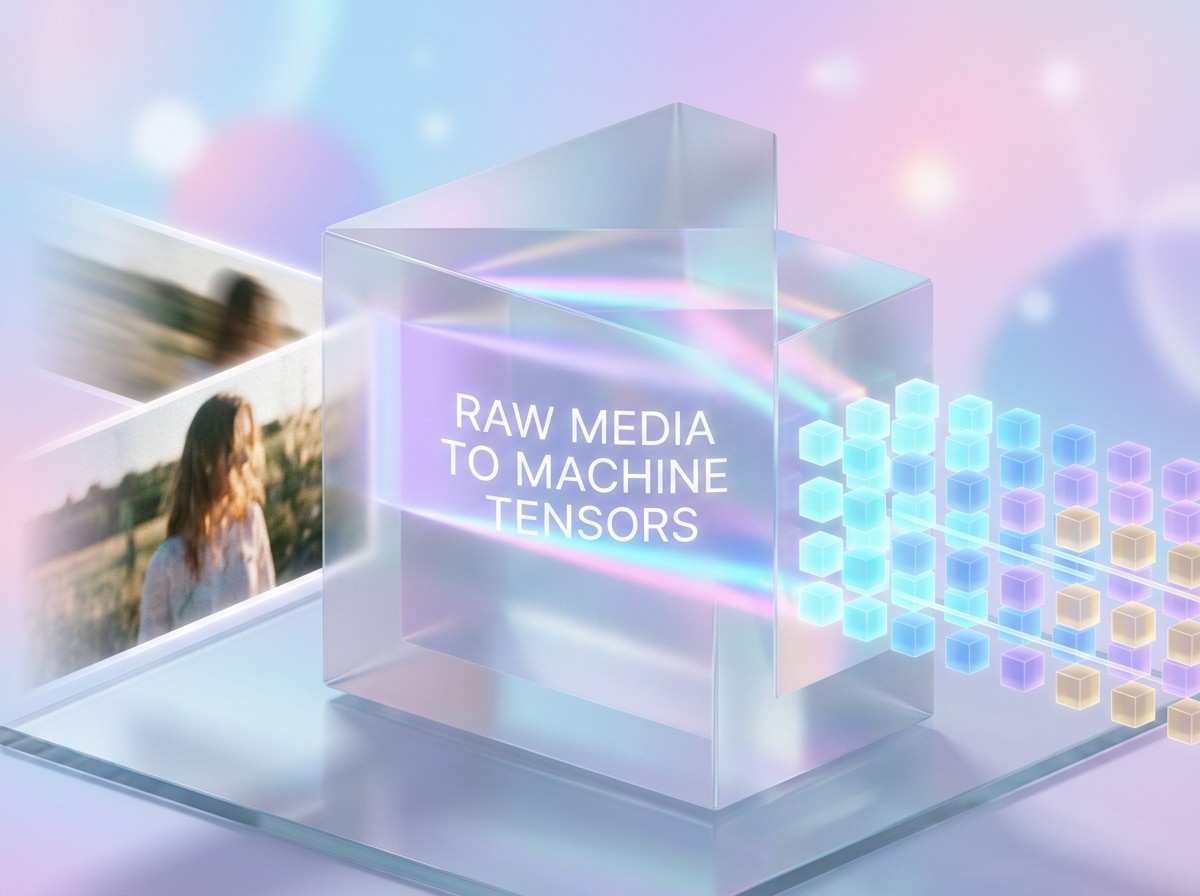
For enterprise machine learning teams, raw media is only half the battle. A massive folder containing thousands of high-resolution MP4s cannot be fed directly into an AI training pipeline without extensive preprocessing. The real bottleneck in model development lies in converting raw visual assets into high-density machine-ready tensors.
Without clean and structured metadata, model training becomes computationally inefficient, leading to slow convergence times and terrible concept association.
The Four Stages of Data Preparation
To transform raw video and imagery into enterprise-grade assets, data teams require a flawless ingestion architecture.
The Ingestion Pipeline Breakdown
Key Prep Requirements
High-Density Semantic Captioning: Detailed text descriptions capturing subject actions, lighting, and camera angles.
Spatial & Bounding Box Annotation: Precise object labeling and spatial coordinates for detection models.
Temporal Segmentation: Splitting raw video clips into discrete, motion-consistent chunks.
Cloud Storage Formatting: Packaging visual data directly into WebDatasets, TFRecords, or Parquet files.
Reclaiming GPU Bandwidth
Most AI engineering teams waste up to 80% of their operational bandwidth manually cleaning scraped web media.
The True Cost of Internal Data Prep
High Engineering Overhead: Engineers spend time labeling images instead of optimizing model architectures.
Slower Iteration Cycles: Raw data bottlenecks delay scheduled model retraining runs.
Inconsistent Annotation: Manual in-house labeling often introduces human labeling errors.
Streamlining ML Pipelines with ShotWot
ShotWot is designed specifically to eliminate data prep friction for AI developers.
Machine-Ready Data Delivered
Rich Native Metadata: Assets paired with dense semantic tags and structured spatial context.
Pre-Formatted Architecture: Formatted for instant conversion into tensors for GPU clusters.
Zero Overhead: Skip the cleaning phase and move straight to model fine-tuning.